Symbiotic Piracy: How Automated Media Circulation Organizes Creative Content in K-Pop's Copyright Shadow
·
Symbiotic Piracy: How Automated Media Circulation Organizes Creative Content in K-Pop's Copyright Shadow
Author: Nash Ang, MFA Affiliation: PinoySeoul Media Enterprise, Philippines & South Korea 0009-0001-7920-4027 | [email protected]
Abstract
This paper introduces the concept of symbiotic piracy to theorize an informal organizational arrangement in which automated media circulation sustains diaspora communities and cultivates overseas audiences in spaces formal commercial channels do not prioritize. Drawing on the illustrative documentary case of Pinoy Seoul Radio, an automated internet radio station streaming Korean music to Filipino migrant workers in South Korea and listeners across Southeast Asia, the paper examines how informal distribution networks and formal intellectual property regimes interact under conditions of regulatory ambiguity. Operating from its March 2020 test broadcast through its multi-year pandemic broadcasting lifecycle under an unresolved licensing status, the station maintained sustained persistence across digital streaming directories without public copyright enforcement. The paper theorizes this persistence through the lens of tactical forbearance, evaluating whether rights holders accommodate grassroots webcasting to preserve cultural reach, while considering alternative explanations including monitoring costs, jurisdictional fragmentation, and directory obscurity. Situating this dynamic within the K-pop industry, the study provides a grounded conceptual vocabulary for understanding how creative organizing navigates intellectual property shadows.
Somewhere in a cloud server managed from Seoul, an automated webcasting service runs continuously without a live studio disc jockey. It carries no programmatic in-stream audio commercials or listener subscription paywalls. The station operates on AzuraCast, an open-source web radio platform using Liquidsoap, rotating through structured programming blocks of Korean pop music, television soundtracks, fan-produced lofi instrumental arrangements, and Original Pilipino Music alongside syndicated community news broadcasts. The platform positions itself toward overseas Filipino workers in South Korean industrial sites, prospective labor migrants preparing for Korean language exams in the Philippines, and listeners across Southeast Asia who cannot find continuous Korean music on domestic commercial FM radio.
The station is called Pinoy Seoul Radio, operating as an audio service under PinoySeoul Media Enterprise within the cultural umbrella of OBRA Incorporated. It streams across online radio directories including Zeno.FM, alongside a dedicated Android application on Google Play and open-source documentation on GitHub (Pinoy Seoul Radio, n.d.). Operating within the emergent spaces of digital audio circulation, diaspora webcasters navigate collective administration models designed around established domestic broadcasters, where rights in South Korea are administered separately across bodies including the Korea Music Copyright Association, the Recording Industry Association of Korea, and the Federation of Korean Music Performers (Korea Copyright Commission, 2020; Towse, 2019). Throughout its multi-year operational lifecycle spanning from the 2020 pandemic onset through late 2023, the station maintained sustained persistence across online streaming directories, recording no public takedown notices, formal disputes, or copyright lawsuits from Korean rights holders or entertainment agencies.
From a conventional intellectual property perspective, Pinoy Seoul Radio should not exist. From the perspective of creative organizing in the K-pop ecosystem, it performs irreplaceable work.
This paper introduces the concept of symbiotic piracy to make sense of this paradox. Symbiotic piracy describes an informal organizational arrangement where automated broadcasts provide essential cultural grounding and community carework for transnational migrants. These grassroots operations serve listeners in geographic and social spaces that commercial licensing models overlook. The persistence of these broadcasts, alongside the institutional tolerance that surrounds them, highlights how formal copyright regimes and informal cultural circulation depend upon one another in practice.
The study contributes to organization studies and media governance by offering a framework for practices that categories of piracy as theft or ideological resistance overlook. By examining how organizations navigate property rights in everyday routines, the paper illustrates how selective non-enforcement can be conceptualized as an adaptive organizational posture. Furthermore, the spread of digital audio tools and generative media deepens this ambiguity, establishing regulatory uncertainty as a routine operating condition for contemporary cultural organizing.
2.1 Living copyright and the practice of non-enforcement
Orthodox treatments of copyright infringement share a common premise: that unauthorized reproduction and distribution of creative content is a zero-sum transfer of value from rights holders to infringers. While conventional legal doctrine positions intellectual property management primarily as preventing unauthorized copying and lost revenue, strategic management scholars emphasize that effective IP strategy requires balancing formal protection with selective openness and downstream value capture (Fisher & Oberholzer-Gee, 2013). Digitalization has intensified this focus, driving enforcement regimes, digital rights management, and international trade agreements designed to align actual circulation with formal property rights (Greenstein et al., 2013).
The difficulty arises when the premise is applied to non-commercial, community-organized, and automated forms of media circulation that do not compete with official distribution channels because they serve audiences, geographies, and social functions that official channels do not reach. In these cases, the zero-sum framework produces a conceptual blind spot: it registers technical infringement while overlooking how informal circulation builds overseas audiences, strengthens cultural connections, and introduces music to new listeners.
A growing body of organization studies addresses this blind spot by examining copyright as an evolving, negotiated social practice. In digital creative fields, informal networks historically paved the way for formal markets; in the Japanese anime industry, studios exhibited a complex, shifting posture toward overseas fansubbing, at times tolerating informal translation groups because they cultivated international consumer demand that licensed streaming platforms later commercialized (Condry, 2013). Creative organizations routinely manage regulatory uncertainty through pragmatic accommodation and calculated ambiguity (Dobusch et al., 2021). Across digital platforms, communities actively sustain fair use and informal circulation through shared norms that balance statutory copyright with creative practice (Aufderheide & Jaszi, 2018).
These perspectives converge on a foundational premise: copyright functions as a living set of organizational routines shaped by everyday social practice rather than an absolute statutory boundary. Symbiotic piracy extends this foundation by examining how selective non-enforcement operates as a structural component of digital media ecosystems, enabling informal broadcasts to fulfill cultural and communicative functions that formal commercial licensing systems fail to serve.
2.2 Informal media economies and shadow distribution
The framework also draws on scholarship documenting shadow distribution networks as core parts of global media circulation rather than marginal distortions (Lobato, 2012). Across much of Asia, Africa, and Latin America, informal channels function as permanent structural features of the broader media economy (Lobato & Thomas, 2015), serving as primary conduits for cultural access. In Asian contexts specifically, scholars observe that while formal statutory copyright frameworks historically developed alongside international commercial trade agreements, informal circulation has long functioned as an adaptive community infrastructure facilitating everyday cultural access and regional creative exchange (Pang, 2006). Within digital platforms, informal copying and adaptation evolve into participatory remix practices (Fagerjord, 2009), transforming creative reinterpretation into a mode of cultural engagement and community dialogue (Pang, 2012).
These scholars share an interpretivist commitment to understanding informal distribution from the perspective of the communities and actors who organize and sustain it, rather than evaluating it solely against the normative standards of formal property law. Whereas tolerated use conceptualizes non-enforcement as a unilateral legal concession by rights holders (Wu, 2008), this paper extends that insight to theorize symbiotic piracy as a relation of bidirectional structural interdependence: the community webcaster relies on formal creative industries for culturally vital repertoire, while rights holders benefit from organic audience cultivation in overseas territories. Symbiotic piracy extends their analysis by examining automated media circulation through automated cloud servers and scheduled playlists, theorizing how formal rights holders and informal community curators support each other in practice.
2.3 GenAI derivatives and the new copyright blur
Generative AI introduces an additional layer of complexity to the management and organization of creative content, moving intellectual property concerns from isolated legal niches directly into everyday organizational routines (Dobusch et al., 2021; Hondros et al., 2024). Digital tools enable fan communities to produce synthetic vocal covers and acoustic reimaginings that mimic established artist voices, occupying undefined regulatory spaces within statutory frameworks (Galuszka, 2025). These technological shifts transform creative problem-solving and knowledge production across organizational fields (Boussioux et al., 2024). In professional and research settings, automated systems introduce tension with established community craft traditions and autonomy (Bechky & Davis, 2025), raising pressing economic questions regarding artist compensation, moral rights, and content provenance (Jiang et al., 2023), while leaving the boundaries separating human from machine creativity under active social construction (Grodal et al., 2024).
Within this operational landscape, generative media and digital remix tools introduce an additional layer of copyright indeterminacy on top of informal distribution networks. When Pinoy Seoul Radio streams a fan-made lofi arrangement or piano cover of a BTS track sourced from public video and audio sharing platforms, multiple layers of unresolved copyright overlap: the original composition held by KOMCA-registered songwriters, the sound recording held by the artist's label, Big Hit Music under HYBE, and the derivative arrangement whose legal status remains largely unsettled. This multi-layered ambiguity is not a rare exception; it reflects everyday creative circulation in the current digital landscape, where rights holders generally respond with selective, strategic tolerance rather than immediate legal action.
3. Case Illustration: Pinoy Seoul Radio
Methodological note
This conceptual essay uses Pinoy Seoul Radio as an illustrative case selected for its capacity to ground theoretical development rather than for statistical representativeness (Stake, 1995; Yin, 2018). In organization studies, a transparent case generates theoretical insight by anchoring abstract institutional boundaries and regulatory ambiguity within an observable, real-world setting (Flyvbjerg, 2006; Yin, 2018). Rather than testing formal causal hypotheses or proving private executive deliberations, the case provides qualitative grounding for theorizing how informal media circulation and formal copyright regimes coexist.
Pinoy Seoul Radio serves as an effective illustrative case because it combines, in a single observable setting, structural features that are widely shared across the broader informal digital media landscape: fully automated playout, community orientation under a hybrid organizational model, multi-layered copyright ambiguity spanning original tracks and derivative arrangements, and cross-border online streams. Far from being an isolated anomaly, the station illustrates a systemic organizational dynamic, symbiotic piracy, that operates across digital fan networks within complex multi-jurisdictional regulatory shadows.
The material for this illustration draws on publicly accessible primary sources: the station's open-source software setup as documented in its public GitHub repository (PinoySeoul, n.d.), its operational statements and schedules on official web portals, listings and metadata across public streaming directories, mobile application documentation on Google Play, and independent news reporting (GoodNewsPilipinas, 2020). As a methodological positionality note, the analysis approaches these materials from an external observational standpoint, evaluating public organizational statements, technical setups, and community partnerships as observable evidence of diaspora cultural organizing in copyright's shadow.
3.1 Pandemic genesis and diaspora carework
Pinoy Seoul Radio was publicly announced as a test broadcast on March 15, 2020, during the initial onset of the COVID-19 pandemic in South Korea. Established under the cultural umbrella of OBRA Incorporated and operated through PinoySeoul Media Enterprise, the station was launched to provide cultural comfort, psychosocial grounding, and community information for an estimated population of approximately 56,000 to 60,000 Filipino residents in South Korea during the pandemic period (Korea Immigration Service, 2020). These residents, primarily factory workers under the state Employment Permit System, technical trainees, married immigrants, and students, faced acute spatial and social isolation: strict pandemic workplace restrictions and language barriers compounded the everyday isolation experienced in suburban factory towns (PinoySeoul, 2020).
The station's operational logic was rooted in community solidarity rather than commercial entertainment. Shortly after launching, the station partnered with independent media initiatives to simulcast community relief updates, global migrant stories, and civic campaigns through programs such as Good News Pilipinas Live (GoodNewsPilipinas, 2020). This community mission established the defining character of the service: Pinoy Seoul Radio operates as an act of diaspora carework, providing a grassroots audio space that sustains cultural connection and community well-being across borders. The parent platform had previously established institutional credibility for its public advocacy, having received the Interactive Media Award for Best Website on Migration from the Commission on Filipinos Overseas at the Migration Advocacy and Media Awards (Commission on Filipinos Overseas, 2019).
The station's transition from emergency conduit to ongoing webcaster occurred as its public positioning expanded. In its operational statements and application listings, the operator positions the service as addressing three overlapping listener groups: transnational workers seeking cultural grounding, prospective migrants in the Philippines utilizing Korean audio streams for everyday language familiarity ahead of EPS-TOPIK exams, and regional popular culture enthusiasts seeking continuous Korean music webcasts unavailable on domestic terrestrial FM radio (PinoySeoul Media Enterprise, n.d.).
3.2 The automated playout architecture
The station's technical infrastructure is designed for automated broadcasting at minimal operating cost. The station uses AzuraCast, an open-source web radio platform running Liquidsoap to manage automated playlists, audio streaming, track titles, and scheduled programs (PinoySeoul, n.d.). The audio streams at 128 kbps, an efficient rate that works well on mobile phones with limited internet connections (PinoySeoul Media Enterprise, n.d.). This setup represents broadcast automation rather than generative artificial intelligence: it plays audio files automatically without requiring a live radio host.
The broadcast runs without a live studio disc jockey, operating through pre-programmed 24-hour schedule blocks that coordinate playlist rotations and syndicated community programs. Programming blocks rotate across 24-hour schedules, including Hallyu Cafe Music and K-Pop Instrumentals for soft acoustic and lofi arrangements, K-Pop Fresh Hits for contemporary chart releases, and K-Drama OST Feels for television drama ballads (PinoySeoul Media Enterprise, n.d.; Radio-Philippines, n.d.). For its diaspora audience, these instrumental and lofi blocks function as ambient listening tailored for night shifts, study sessions, and language preparation for the EPS-TOPIK examination. Syndication blocks feature Good News Pilipinas Live, relaying civic news and diaspora advocacy produced in partnership with studios in Metro Manila (GoodNewsPilipinas, 2020).
The playlist curation touches directly upon the copyright indeterminacy examined in this paper. Alongside commercial studio releases by major agencies such as HYBE, SM, YG, and JYP, the automated rotation integrates participatory fan derivative works, including acoustic covers, ambient lofi edits, and community remixes sourced from public video and audio sharing platforms. Many contemporary fan producers utilize neural-network stem separation and automated audio tools to isolate vocal or melodic tracks from original recordings, creating new instrumental arrangements. By scheduling official studio recordings alongside informal fan derivative arrangements within the same automated broadcasting playlist, the station demonstrates how digital distribution systems routinely combine formal and informal creative works within everyday organizational routines.
3.3 The licensing impasse
Formal copyright licensing presents a substantial structural challenge for grassroots webcasters like Pinoy Seoul Radio, and this challenge offers valuable lessons for organization theory. Statutory tariffs for digital audio transmission exist in principle; under the Korea Copyright Commission's approved collection regulations, webcasting royalties are calculated through established rate schedules based on transmission type and listener access (Korea Copyright Commission, 2020). However, the administrative structure of collective management presents a formidable coordination barrier with high transaction costs. Organizationally, the station operates as a hybrid community initiative (Battilana & Dorado, 2010): its primary mission focuses on providing free cultural continuity and support for migrant workers, while the wider media portal seeks brand sponsorships, community partnerships, and advertising placements to cover technical hosting expenses. While the parent media portal explores commercial partnerships to subsidize server hosting and technical upkeep, the audio broadcast stream itself remains free to listen, carrying no programmatic in-stream audio commercials, pre-roll audio advertisements, or listener subscription paywalls.
The primary operational barrier stems from rights fragmentation and cross-border jurisdiction. In music licensing, rights are split across multiple collective management organizations: securing composition rights through KOMCA does not cover master recording rights managed by RIAK, nor performer neighboring rights administered by FKMP. Furthermore, webcasting simultaneously across South Korea and Southeast Asia introduces territorial ambiguity regarding whether domestic transmission rules or destination-market clearances apply. Tracking thousands of rotating tracks, reporting detailed play logs, and navigating separate administrative bodies requires institutional infrastructure, legal counsel, and accounting overhead that vastly exceed the budget of a volunteer diaspora initiative.
This condition demonstrates that the barrier to formal compliance in grassroots digital media is often administrative rather than ideological. It is a coordination and transaction-cost gap rather than the total statutory absence of tariffs. For small community webcasters, the administrative burden of clearing multiple rights across national borders creates a structural impasse, leaving informal circulation as the only viable organizational mode for sustaining cultural continuity.
3.4 Multi-year organizational persistence
The most analytically significant feature of Pinoy Seoul Radio's multi-year trajectory is not its technical deployment but its organizational persistence. From its initial test broadcast in March 2020 through the conclusion of its active emergency pandemic programming in late 2023, the station maintained continuous streaming across its mobile application and primary directories like TuneIn and Zeno.FM, even as listings on secondary aggregator directories periodically shift. Following the lifting of pandemic restrictions, the station's operational records and automated playout architecture were transitioned into a public cultural preservation archive. Across public court registries, entertainment trade publications, and intellectual property dispute databases throughout this multi-year operational period, we identified no public record of copyright litigation, formal disputes, or takedown notices directed at the station.
This de facto persistence can be conceptualized through several plausible organizational mechanisms. One plausible conceptual explanation is tactical forbearance, building on Wu's (2008) framework of tolerated use: rights holders may recognize that grassroots community webcasters maintain cultural connection and language engagement among transnational audiences without diverting subscription revenues from licensed commercial platforms, adopting a posture of deliberate non-enforcement toward fan and diaspora broadcasts that do not replace paid services. Simultaneously, organizational persistence must be understood alongside critical structural explanations: significant monitoring and cross-border enforcement costs relative to negligible financial recovery (Landes & Posner, 1989; Towse, 2019), the relative obscurity of independent web directories, and the prioritization of corporate legal resources toward commercial piracy and counterfeit merchandising. While major entertainment agencies deploy automated algorithmic claiming on large commercial platforms like YouTube to monetize fan content, independent open-protocol webcasts lack automated monetization interfaces, meaning enforcement requires costly manual legal intervention. Rather than assuming unobserved corporate decisions or formal whitelists, the paper conceptualizes tactical forbearance as an institutional posture that operates in tandem with platform enforcement economics to permit informal cultural organizing to endure.
4. The K-Pop Paradox: Symbiotic Piracy at Industry Scale
4.1 The consumption engine of Southeast Asia
The organizational persistence of informal webcasting reflects structural dynamics in the K-pop industry's relationship with Southeast Asian growth markets. In 2025, the Philippines ranked among the top four markets globally in total Spotify K-pop streaming volume, joining the United States, Indonesia, and Japan in driving international listening hours (Inquirer, 2025). On digital platforms, the country regularly ranks among the top global territories for K-pop social media conversation volume and unique active participants (Adobo Magazine, 2022). Industry market studies highlight the territory as one of the fastest-growing digital music markets in the region, with streaming accounting for over ninety percent of recorded music revenue (IFPI, 2024).
Yet commercial FM broadcast stations in the Philippines offer limited and non-continuous Korean music airtime. Local programming is dominated by domestic pop and Western Top 40 rotations. This disparity creates a distinct format and structural access gap: while high-income consumers access K-pop on paid streaming platforms, overseas factory workers and regional listeners require continuous, low-bandwidth, ambient radio webcasting that commercial FM outlets do not supply. Stations like Pinoy Seoul Radio emerge as informal infrastructure filling this programming gap.
The logistical investment required to establish syndicated terrestrial radio distribution across the Philippines, an archipelagic nation of over seven thousand islands, lies outside the core operational focus of Korean agencies, whose international models prioritize streaming platforms, concert tours, and physical merchandise. Pinoy Seoul Radio and the community streaming ecosystem provide the continuous, low-bandwidth, ambient audio presence that formal broadcast channels do not supply. Grassroots diaspora webcasters and regional fan networks function, in organizational terms, as community cultural guides and grassroots ambassadors who broaden international engagement.
4.2 Fan labor and the downstream recapture loop
The K-pop industry's treatment of non-monetized fan activity illuminates the organizational logic of symbiotic piracy at a larger scale. Major entertainment agencies maintain a dual enforcement posture that is not contradictory but strategically coherent. They aggressively enforce copyright against commercial competitors: unauthorized merchandise sellers, rival platforms that monetize content without licensing, and entities that profit directly from copyrighted material. Simultaneously, they systematically tolerate an enormous volume of non-monetized fan labor: community streaming channels, fan-cam recordings distributed on YouTube, translation and subtitling networks that make Korean-language content accessible to global audiences, and organized fan streaming campaigns that sustain chart visibility and global trending metrics (Jin, 2016). This selective tolerance reflects platform capitalism's reliance on fan-driven participatory labor as the primary engine for global cultural expansion.
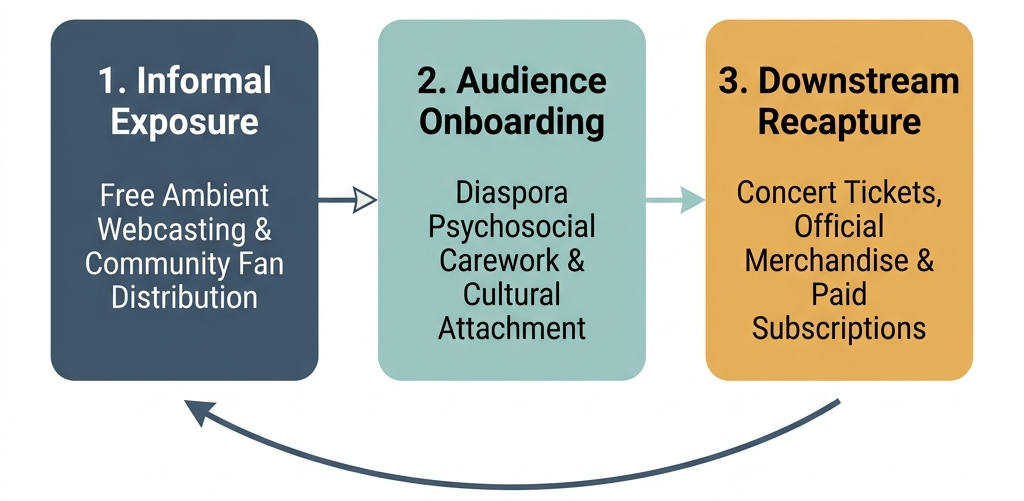
This tolerance reflects an organizational logic wherein non-monetized circulation builds audience engagement that later converts into concert ticket and merchandise sales. This dynamic mirrors the broader history of global K-pop expansion, where entertainment agencies accommodated unauthorized fan subtitling networks, translated reaction channels, and community webcasting during the early digital expansion of the Korean Wave, establishing international listener networks in Latin America and Southeast Asia years before formal local distribution infrastructure existed (Jin, 2016). In this context, the paper conceptualizes a downstream recapture loop: a Filipino factory worker in Gyeonggi-do who listens to Pinoy Seoul Radio during her shift and discovers a new release does not necessarily represent a lost commercial transaction; rather, informal exposure serves as a hypothesized pathway toward downstream participation, such as concert attendance when artists tour Southeast Asia, community membership, or physical merchandise purchases. The K-pop business model operates through an audience development pathway: free or low-cost digital exposure at the entry point fosters deep cultural attachment that later translates into participation in live concerts and official merchandise. As illustrated in Figure 1, informal distribution channels and community-organized fan networks sit at the entry gateway of this ecosystem, performing the continuous exposure and early cultural introduction that official channels cannot deliver at scale.
[Alt text: Diagram showing a flow from left to right. On the left, informal distribution channels including diaspora webcasters and fan remix networks feed into a central zone labeled audience discovery and cultural connection. From this zone, arrows lead rightward to downstream commercial participation including concert attendance, merchandise purchases, and fan memberships. A dashed boundary labeled tactical forbearance separates the informal circulation zone from the formal rights enforcement zone above.]
Figure 1. Conceptual Model of Symbiotic Piracy. Informal distribution fosters early audience discovery and cultural connection in markets unserved by formal broadcast channels, establishing a listener base that rights holders later monetize through downstream products and events under a strategic posture of tactical forbearance.
4.3 Derivative remix culture in the shadow of GenAI
Generative AI and machine-learning audio tools have deepened and complicated the symbiotic piracy dynamic in ways that existing copyright frameworks are not equipped to address. Across informal digital networks, participatory fan creations, including lofi remixes, acoustic reinterpretations, and algorithmically curated playlists, constitute a growing layer of digital media circulation where rights holders navigate fan engagement against statutory copyright enforcement (Galuszka, 2025). These works circulate widely on video and audio sharing platforms, where they are added to automated broadcast playlists like Pinoy Seoul Radio's alongside original commercial releases. Contemporary fan producers increasingly rely on machine-learning stem separation software to isolate vocal acapellas and musical motifs from commercial releases, weaving protected melodies into new ambient arrangements.
The copyright status of emerging AI-assisted and synthetic derivative arrangements remains highly contested across international jurisdictions. In South Korea, official copyright guidance affirms that purely autonomous artificial intelligence outputs do not qualify for copyright protection due to the statutory requirement for human authorship, although human creative arrangement, selection, or modification may receive protection (Ministry of Culture, Sports and Tourism & Korea Copyright Commission, 2023). Importantly, isolating a stem or modifying an audio track through machine-learning software does not eliminate the copyright held in the underlying composition or original sound recording. When digital creators utilize generative audio tools and stem extraction alongside conventional digital audio workstations to produce ambient lofi arrangements or acoustic covers of protected melodies, they operate in an indeterminate regulatory space: the derivative track reinterprets the composition, raises ethical and economic questions regarding artist compensation and attribution (Jiang et al., 2023; Galuszka, 2025), yet simultaneously creates everyday listening opportunities that keep songs and artists visible across digital networks.
The boundary between human and machine creativity is socially constructed and actively negotiated rather than technically determined (Grodal et al., 2024). The K-pop informal distribution ecosystem illustrates this negotiation in practice. When the station streams an informal lofi cover or derivative arrangement of Spring Day by BTS, ownership boundaries remain undefined across the chain: the broadcaster, the listener, the derivative creator, and the original label all navigate an ambiguous legal space. The creative system functions smoothly within this ambiguity, sustained by mutual tolerance rather than continuous legal challenge.
5. What Symbiotic Piracy Reveals About Creative Organizing
5.1 Conceptual contributions to creative organizing
The dynamics of symbiotic piracy offer substantive conceptual insights into the relationship between creativity, copyright, and organizational practice in the GenAI era.
At the conceptual level, symbiotic piracy articulates an unwritten practical alternative to statutory copyright regimes, directly engaging debates on managing creative content in the shadow of technological and regulatory uncertainty (Dobusch et al., 2021; Hondros et al., 2024). Rather than relying on formal property titles or structured open-access commons, these practices present an informal organizational arrangement operating below statutory frameworks, sustained by tacit mutual recognition that the status quo serves formal and informal actors better than rigid administrative barriers or mutually disadvantageous enforcement. Its distinctiveness as an alternative lies in its emergent, unwritten, and strategically flexible character. No formal contract governs the relationship between community webcasters and Korean entertainment agencies, and no public policy codifies the boundaries of forbearance. The arrangement persists as an unwritten practical modus vivendi: formal rights holders and informal webcasters operate in a space where pragmatic tolerance allows cultural connection to grow without active legal dispute.
Beyond framing structural alternatives, this arrangement illustrates how living copyright functions through everyday organizational routines (Hondros et al., 2024). Formal property rights are routinely shaped by decisions regarding when and where to withhold enforcement. In the K-pop ecosystem, selective enforcement reflects a consistent organizational pattern: intellectual property is strictly protected against commercial rivals, while non-commercial community distribution is accommodated. Withholding legal action carries real organizational consequences, shaping how media is discovered and consumed in underserved territories. Because property rights function as negotiated social relations rather than absolute legal facts (Carruthers & Ariovich, 2004), symbiotic piracy demonstrates that the non-exercise of property rights is an active social practice shaping market dynamics.
At the institutional scale, these informal arrangements illuminate the administrative and jurisdictional boundaries of contemporary copyright governance. In the study of creative ecosystems, innovation and cultural vitality often depend upon intermediate community hubs that link grassroots fan creativity with formal commercial industries (Cohendet et al., 2010; Sultana et al., 2023). Pinoy Seoul Radio illustrates this bridging function: it channels the participatory remix labor and devotion of fans into sustained listener communities that build overseas familiarity for Korean popular culture. The case demonstrates that even where statutory tariffs exist in principle, the fragmented administration of multi-layered rights across separate collective management bodies creates an insurmountable barrier of high coordination and licensing costs for cross-border community webcasters. Symbiotic piracy emerges as a practical organizational adaptation, illustrating how informal circulation bridges institutional boundaries when formal licensing systems prove too fragmented to navigate.
5.2 Creative organizing in the shadow of GenAI
While regulatory uncertainty in creative industries is frequently theorized as generating anxiety or hope among industry actors (Dobusch et al., 2021), symbiotic piracy reveals a third operational state: pragmatic accommodation. The actors in this paper's case, including the diaspora media operator, the migrant worker listener, the digital remix creator, and the Korean entertainment conglomerate, experience regulatory ambiguity as an organizational background condition, a persistent feature of the environment to which they have adapted practical routines.
This reframing has implications for how scholars and practitioners understand the relationship between technological change and regulatory adaptation. The conventional framing treats the gap between fast-moving technology and slow-moving regulation as an institutional problem: a mismatch to be corrected through updated legislation, new licensing models, or industry self-regulation. Symbiotic piracy demonstrates that this regulatory gap functions as a strategic resource for creative organizing and institutional work (Lawrence & Suddaby, 2006). The K-pop ecosystem's global reach, its penetration of underserved markets, and its capacity to sustain continuous audience formation across international territories depend in part on the persistence of informal distribution channels that formal copyright compliance would eliminate. The creative economy of Korean popular music expands by accommodating these regulatory gaps, relying on informal community circulation to reach audiences that formal distribution has yet to organize.
Generative AI undeniably introduces surprising disruptions into the creative economy (Amabile, 2020), yet the central surprise illuminated by symbiotic piracy remains organizational rather than purely technological: that in fast-moving creative ecosystems, adaptive forbearance and strategic tolerance can cultivate vibrant audience communities that rigid early enforcement might constrain, and that informal, community-organized curation can foster cultural engagement as meaningfully as formal licensing frameworks.
5.3 Limitations and future directions
The conceptual framework of symbiotic piracy reflects specific organizational conditions that define its analytical boundaries. This dynamic thrives within cultural ecosystems like K-pop, where corporate revenue models depend heavily on downstream monetization, such as live stadium concerts, branded merchandise, interactive fan memberships, and physical collectibles (Jin, 2016). In these environments, broad audience familiarity generated through informal circulation can convert into high-margin commercial participation, making tactical forbearance economically viable.
By contrast, symbiotic piracy faces clear boundary constraints in creative industries reliant on direct unit sales or strict subscription paywalls without auxiliary live experiences. In academic book publishing, professional software, or specialized sheet music distribution, digital leakage directly substitutes for primary sales rather than seeding complementary downstream markets (Towse, 2019; Lobato & Thomas, 2015). In those settings, rights holders operate with narrow tolerance margins and rely on aggressive legal suppression rather than symbiotic coexistence. Comparative research across television, film, and publishing can test where these tolerance thresholds hold or dissolve.
The paper's evaluation of enforcement decision-making within Korean entertainment conglomerates relies on observable structural patterns, including aggressive action against commercial rivals alongside sustained tolerance toward non-monetized streaming. Direct interviews with corporate rights managers represent a key avenue for future empirical investigation.
Another important constraint involves the rapidly evolving legal landscape surrounding AI-generated content and stem separation. Court decisions, legislative proposals, and collective bargaining agreements are currently reshaping the copyright status of AI derivatives in multiple jurisdictions. The zone of indeterminacy that symbiotic piracy currently occupies may narrow as legal frameworks mature. Longitudinal research tracking the formal and informal boundary as regulation develops will provide valuable evidence for how creative organizing adapts to shifting regulatory conditions.
These analytical boundaries outline a productive research agenda: comparative studies of informal distribution networks across cultural industries and regions, interview-based research on enforcement decision-making within creative conglomerates, longitudinal tracking of generative media tools on copyright practices, and ethnographic studies of diaspora media operators navigating the space between structural exclusion and community service.
References
Adobo Magazine. (2022, January 26). Filipinos are one of the most passionate and active K-pop fans in the world. Adobo Magazine.
Amabile, T. M. (2020). Creativity, artificial intelligence, and a world of surprises. Academy of Management Discoveries, 6(3), 351–354.
Aufderheide, P., & Jaszi, P. (2018). Reclaiming fair use: How to put balance back in copyright. University of Chicago Press.
Battilana, J., & Dorado, S. (2010). Building sustainable hybrid organizations: The case of commercial microfinance organizations. Academy of Management Journal, 53(6), 1419–1440.
Bechky, B. A., & Davis, G. F. (2025). Resisting the algorithmic management of science: Craft and community after generative AI. Administrative Science Quarterly, 70(1), 1–22.
Boussioux, L., Lane, J. N., Zhang, M., Jacimovic, V., & Lakhani, K. R. (2024). The crowdless future? Generative AI and creative problem-solving. Organization Science, 35(5), 1589–1607.
Carruthers, B. G., & Ariovich, L. (2004). The sociology of property rights. Annual Review of Sociology, 30, 23–46.
Cohendet, P., Grandadam, D., & Simon, L. (2010). The anatomy of the creative city. Industry and Innovation, 17(1), 91–111.
Commission on Filipinos Overseas. (2019). Migration Advocacy and Media (MAM) Awards: 2019 Awardees. Republic of the Philippines.
Condry, I. (2013). The soul of anime: Collaborative creativity and Japan's media success story. Duke University Press.
Dobusch, L., Hondros, K., Quack, S., & Zangerle, K. (2021). Between anxiety and hope? How actors experience regulatory uncertainty in creative processes in music and pharma. Research in the Sociology of Organizations, 75, 137–160.
Fagerjord, A. (2009). After convergence: YouTube and remix culture. In J. Hunsinger, L. Klastrup, & M. Allen (Eds.), International handbook of internet research (pp. 187–200). Springer.
Fisher, W. W., III, & Oberholzer-Gee, F. (2013). Strategic management of intellectual property: An integrated approach. California Management Review, 55(4), 157–183.
Flyvbjerg, B. (2006). Five misunderstandings about case-study research. Qualitative Inquiry, 12(2), 219–245.
Galuszka, P. (2025). The influence of generative AI on popular music: Fan productions and the reimagination of iconic voices. Media, Culture & Society, 47(3), 603–612.
GoodNewsPilipinas. (2020). Happening now: Good news stories to make Filipinos proud on Good News Pilipinas Live @PinoySeoul Radio. Good News Pilipinas.
Greenstein, S., Lerner, J., & Stern, S. (2013). Digitization, innovation, and copyright: What is the agenda? Strategic Organization, 11(1), 110–121.
Grodal, S., Ha, J., Hood, E., & Rajunov, M. (2024). Between humans and machines: The social construction of the generative AI category. Organization Theory, 5(3), 1–10.
Hondros, K., Dobusch, L., Mager, A., Aufderheide, P., & Cohendet, P. (2024). Call for papers: Creativity and copyright in the shadow of GenAI: Managing and organizing creative content in the digitalization frenzy. Innovation: Organization & Management.
IFPI. (2024). Global music report 2024: State of the industry. International Federation of the Phonographic Industry.
Jiang, H. H., Brown, L., Cheng, J., Khan, M., Gupta, A., Workman, D., Gebru, T., et al. (2023). AI art and its impact on artists. In Proceedings of the 2023 AAAI/ACM Conference on AI, Ethics, and Society (pp. 363–374). Association for Computing Machinery.
Jin, D. Y. (2016). New Korean Wave: Transnational cultural power in the age of social media. University of Illinois Press.
Korea Copyright Commission. (2020). Copyright collection regulations and digital audio transmission guidelines. Republic of Korea.
Korea Immigration Service. (2020). Korea Immigration Service Statistics. Ministry of Justice, Republic of Korea.
Landes, W. M., & Posner, R. A. (1989). An economic analysis of copyright law. The Journal of Legal Studies, 18(2), 325–363.
Lawrence, T. B., & Suddaby, R. (2006). Institutions and institutional work. In S. R. Clegg, C. Hardy, T. B. Lawrence, & W. R. Nord (Eds.), Handbook of organization studies (2nd ed., pp. 215–254). SAGE Publications.
Lobato, R. (2012). Shadow economies of cinema: Mapping informal film distribution. British Film Institute/Palgrave Macmillan.
Lobato, R., & Thomas, J. (2015). The informal media economy. Polity Press.
Ministry of Culture, Sports and Tourism & Korea Copyright Commission. (2023). Guidelines on generative AI and copyright: For AI business operators, copyright holders, and users. Republic of Korea.
Pang, L. (2006). Cultural control and globalization in Asia: Copyright, piracy, and cinema. Routledge.
Pang, L. (2012). Creativity and its discontents: China's creative industries and intellectual property rights offenses. Duke University Press.
PinoySeoul. (2020, March 30). From Seoul to Manila: Building bridges through stories that matter. Medium.
PinoySeoul. (n.d.). Pinoy Seoul Radio application repository. GitHub.
PinoySeoul Media Enterprise. (n.d.). Pinoy Seoul Radio [Mobile application]. Google Play Store.
Pinoy Seoul Radio. (n.d.). Pinoy Seoul Radio stream. TuneIn Radio Directory.
Radio-Philippines. (n.d.). Pinoy Seoul Radio stream. Radio-Philippines.
Stake, R. E. (1995). The art of case study research. Sage.
Sultana, N., Turkina, E., & Cohendet, P. (2023). The mechanisms underlying the emergence of innovation ecosystems: The case of the AI ecosystem in Montreal. European Planning Studies, 31(7), 1443–1465.
Towse, R. (2019). A textbook of cultural economics (2nd ed.). Cambridge University Press.
Wu, T. (2008). Tolerated use. Columbia Law Review, 108(3), 617–678.
Yin, R. K. (2018). Case study research and applications: Design and methods (6th ed.). SAGE Publications.

 Creative Commons Attribution 4.0 International License (CC-BY 4.0)